Approval before payment
The architecture requires approval before check entry and treats exceptions and corrections as auditable records.
Workflow architecture / volunteer operations
Turn a reimbursement into a traceable sequence of evidence, review and human approval.
Architecture case study · Successor implementation and acceptance pending
01 / the operational problem
Volunteer reimbursements combine small records with consequential decisions: what was purchased, which fund covers it, how currency was converted and who approved payment. The design aims to make that chain understandable on a phone and reviewable during handover.
I developed treasury-specific requirements and architecture around approval controls, evidence retention and reproducible outputs. Operational workbook history informed the requirements; it is not acceptance evidence for an application.
02 / proposed workflow
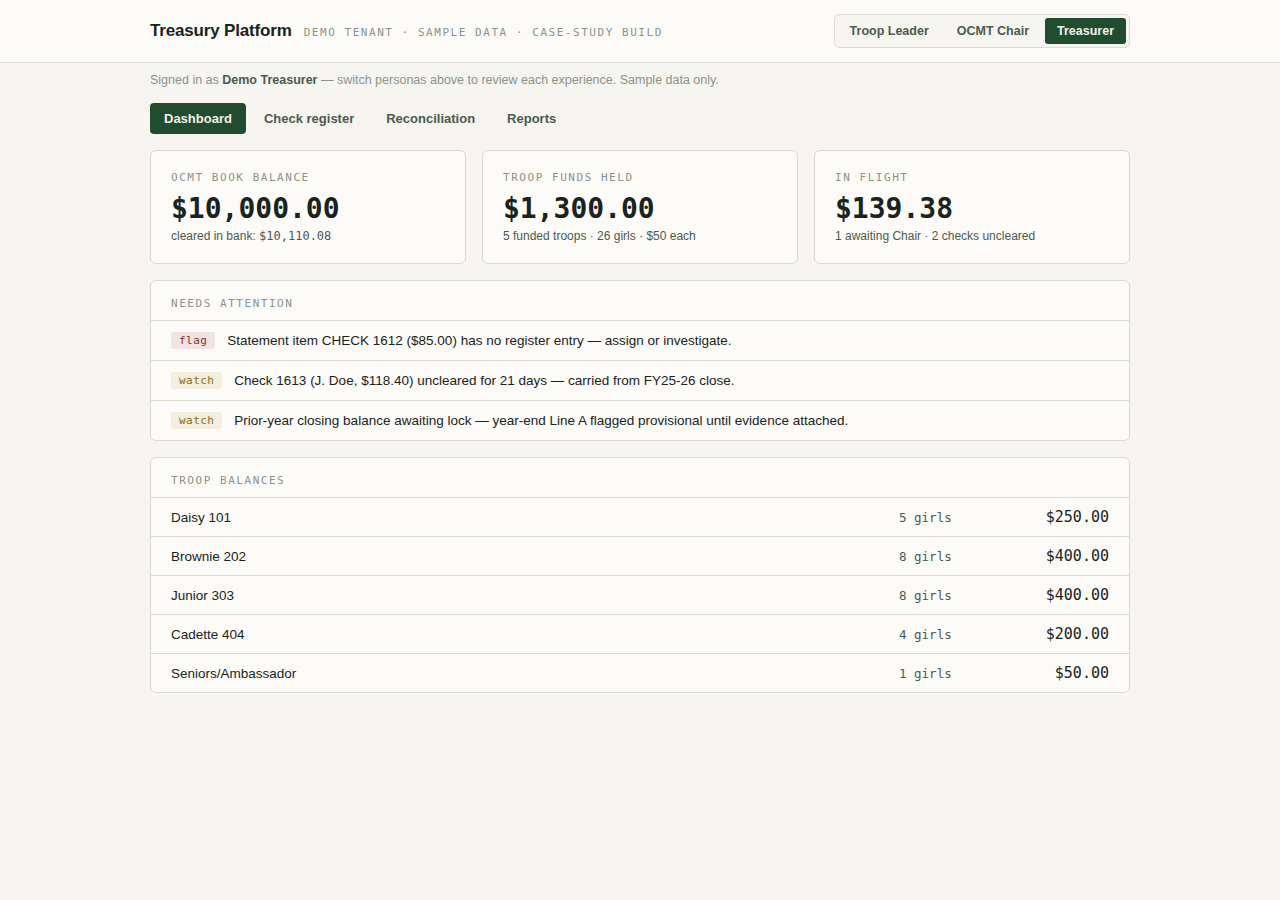
Intended workflow, not an executable demo. A diagram or screenshot does not establish that these controls have been implemented or passed acceptance.
03 / control requirements
The architecture requires approval before check entry and treats exceptions and corrections as auditable records.
The proposed currency rule retains the transaction date, rate evidence and fallback basis. Deterministic logic must be verified separately.
Voucher, reconciliation and reporting designs need defined inputs, retained evidence and acceptance checks.
04 / architecture transition
The earlier design used Next.js, Supabase and Vercel. The November successor direction uses Google Workspace for the request workflow and records. Database-trigger and row-level-security claims from the former architecture do not transfer to the successor.
The next evidence is a verified implementation baseline, controlled workflow and access checks, reproducible output, and operational acceptance. A completed full-year platform pilot has not been verified.
Requirements, architecture, traceability approach and historical fictional-data illustrations. No live application, private financial records, receipt photos, credentials or youth records are embedded or linked.
05 / provenance
Foundation patterns derive from SpendWise, the UMGC CMSC 495 capstone by Leighton Tidwell, Jason Holmes and Eric Hill. Treasury-specific design and code work is distinct from that shared baseline. The public case study records consent for reuse and requires preserving applicable attribution and rights.
This is independent work and does not imply organizational endorsement. The public case-study text and images reserve reproduction rights; code snippets are MIT-licensed unless noted. This page references an existing public illustration and grants no reuse rights.
I connect operational needs to requirements, interfaces, controls and verification under human approval gates.
Start a conversationEvidence reviewed 17 November 2026. No product deployment or transaction performed during this portfolio review.