Problem
Low-cost supervised autonomy needs evidence about vehicle behavior, operator intervention and the quality of its logs. Bob 1 is a proposed small uncrewed surface vehicle for investigating those questions before considering larger cargo platforms.
The immediate engineering problem is configuration control: drawings, electrical concepts and component references need reconciliation before a build can establish trustworthy results. The larger cargo-vessel concept is a separate, crewed development stage.
My role and attribution
I lead the project: defining the research direction, reviewing source records, identifying configuration gaps and setting the evidence required for progression. My analysis and AI-assisted documentation and visualization work support that process.
The project belongs to HDES, whose U.S. LLC formation is reported as in progress. Its archive includes commissioned design work and supplier material with their own provenance and rights. Project leadership does not establish sole authorship of those artifacts. Detailed CAD and working records remain private.
What exists today
Inspect the artifact-by-artifact evidence map
| Artifact | What it supports | Limit |
|---|---|---|
| V03 drawing register | Mechanical assembly, component and electrical references. | No sheet released for fabrication; native CAD assembly validation outstanding. |
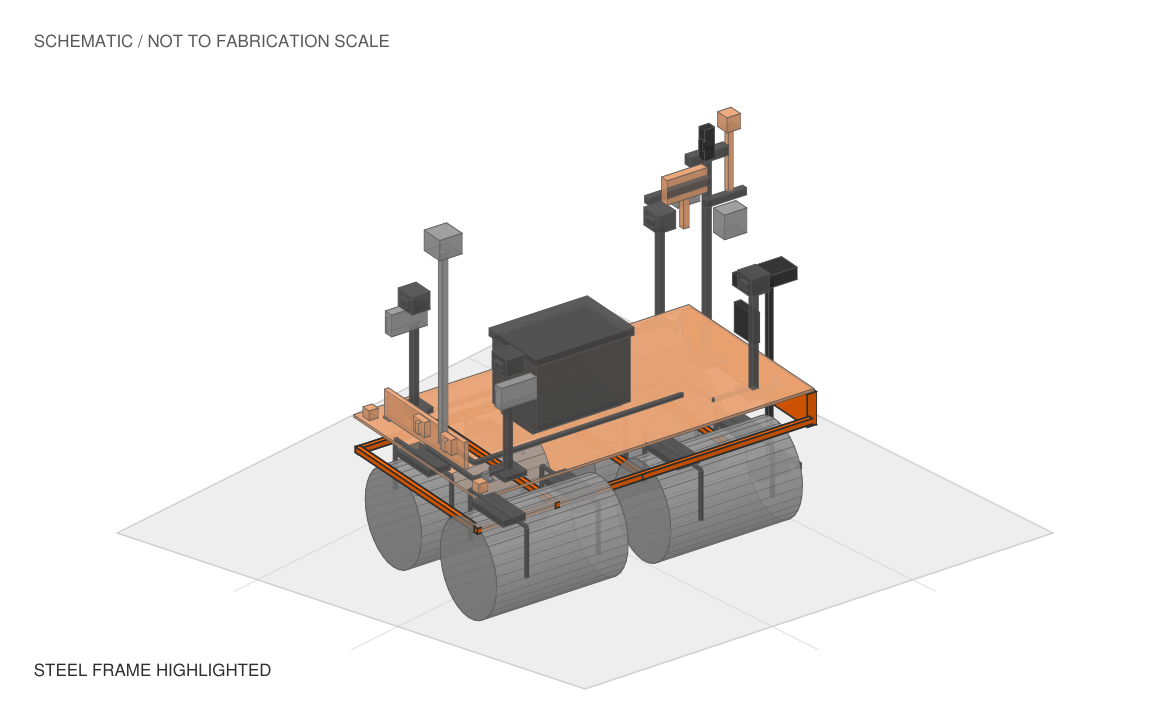
| Visual Explorer v0.3 | Schematic assembled/exploded views, selectable component groups and all 30 top-level parts-list rows. | Illustrative geometry; listed parts do not establish purchase or installation. |
| Flotation scenario calculator | Repeatable ideal-cylinder draft estimates with explicit mass and volume assumptions. | CAD masses and nominal drum volume; no safe payload or stability rating. |
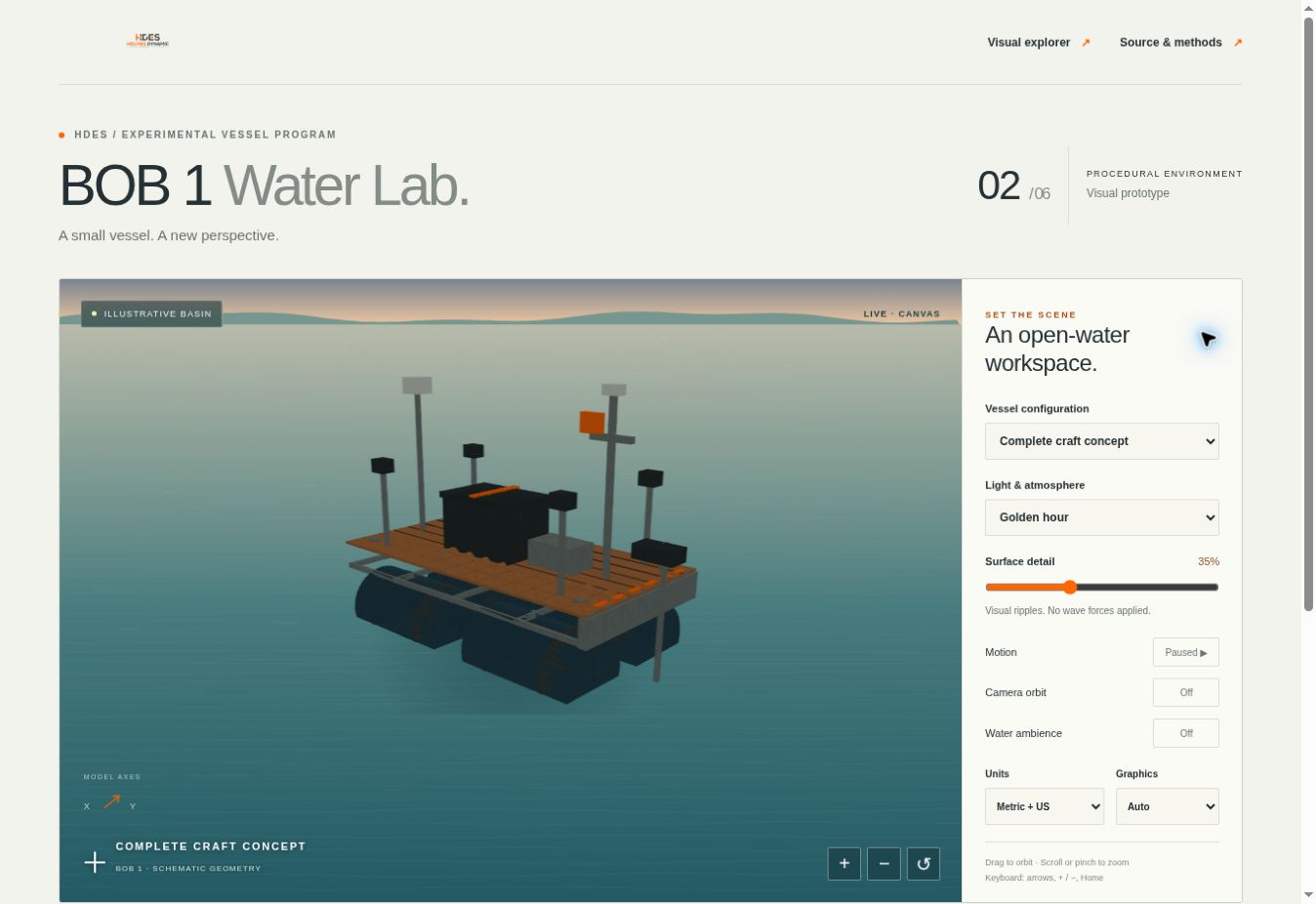
| Water Lab, Phase 2 | Procedural water scene, camera controls and calculated level-draft placement. | Visual ripples apply no wave forces; handling and dynamic stability are unmodeled. |
| Documentation gap assessment | 12 planning areas and a reported draft matrix of 34 candidate requirements. | Coverage counts describe documents; requirements approval and physical test results remain outstanding. |
Engineering decisions and open conflicts
Reconcile power before procurement
The drawing register identifies a 24 V propulsion concept versus a 12 V motor/battery drawing, plus fastener and navigation-light discrepancies. A single approved power, propulsion and interface baseline must precede purchasing and integration.
Separate documented, modeled and measured values
The complete-craft mass of 80.40 kg is a CAD value. Four nominal 60 L drums and an assumed circular shape support a preliminary calculation. These inputs are labeled so a visitor can distinguish source values, assumptions and future measurements. Drum crown clearance is kept distinct from deck freeboard.
Use an established autopilot as a proposed stack
The current proposal uses Cube Orange+ with ArduPilot Rover, a ground station, telemetry and an operator-priority RC path. The hardware has not been purchased, integrated or tested. Control authority, protected power, interfaces and link-loss behavior still need approved specifications.
What was checked
On 17 November 2026, all three existing software-check suites passed at source revision 43b40c7: the Water Lab model, scene geometry/camera checks and Visual Explorer checks. They cover calculation boundaries and scaling, source reference cases, unit conversions, component mapping and controls. These checks validate software behavior within its assumptions.
Browser review confirmed the explorer’s 30-row index, exploded-view control and metric switch. Water Lab loaded a WebGL scene and source-backed reference values in this browser. This is a bounded software demonstration; physical-device performance, real vessel behavior and hardware acceptance are separate checks.
The published physical acceptance criteria still have unapproved numerical targets and untested status. No route accuracy, intervention rate, endurance or payload result is claimed.
Next evidence to earn
- Reconcile drawings, power, propulsion and controls into one approved build configuration.
- Approve measurable requirements, interfaces and a test-specific safety and recovery plan.
- Document procurement and bench integration, including manual override and link-loss behavior.
- Progress through restrained flotation, manual handling and supervised waypoint trials with reviewed criteria.
- Compare measured mass, flotation, telemetry and interventions with the predictions; publish bounded results.
Dates depend on scope, resources and permissions. The research questions remain open; no funding award, certification or confirmed operating partnership is implied.
Sources and rights
This review uses the public project snapshot, its source register, proposed control architecture and staged test plan. Native CAD and physical hardware were not independently inspected here.
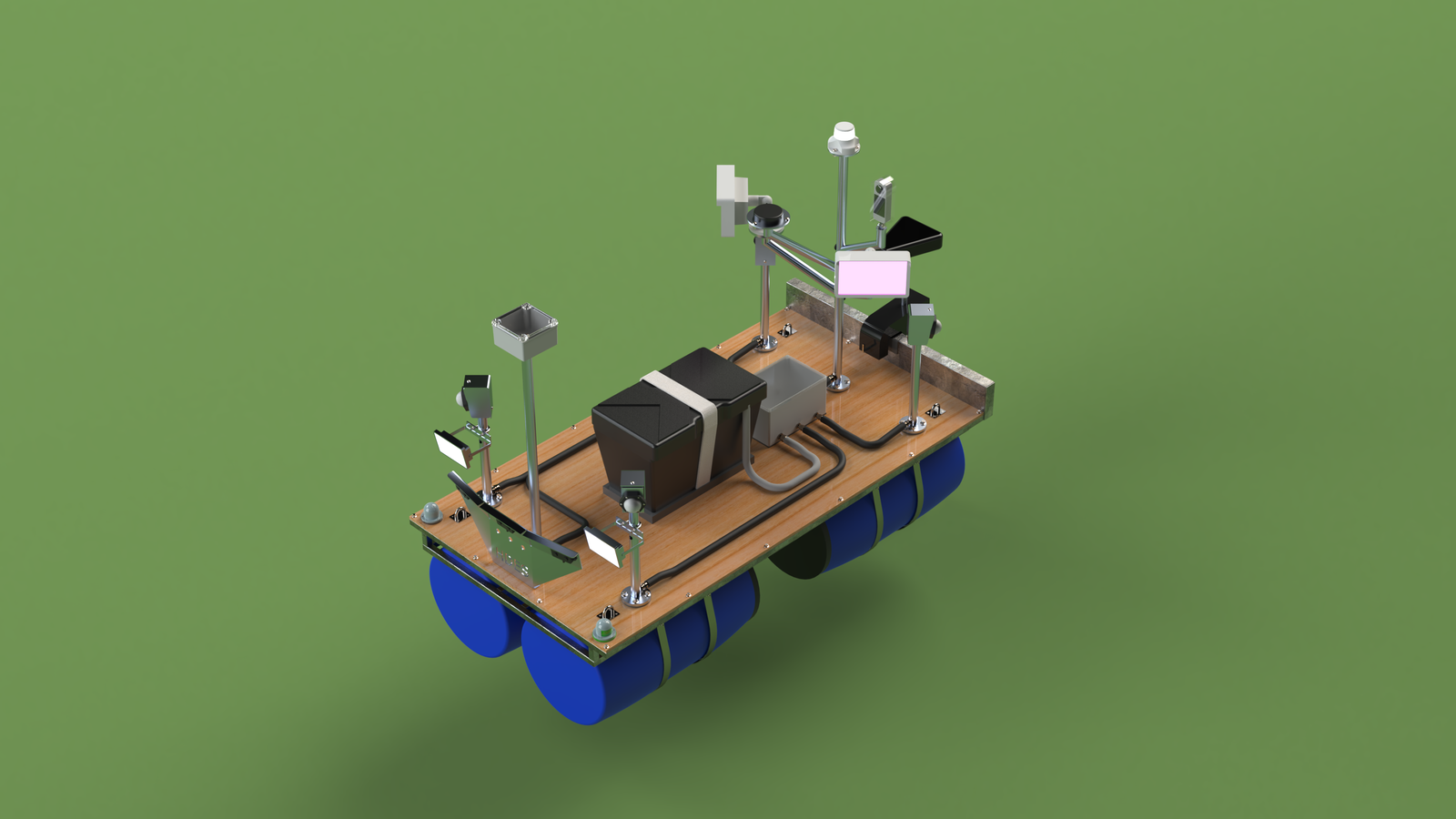
Copyright HDES. All rights reserved. Public access grants no license to commissioned designs, supplier assets or project content. This page references existing public design/software images and links the public tools; it grants no reuse rights. Image captions preserve the distinction between design, visualization and physical evidence.
Evidence reviewed 17 November 2026. Software checks and browser observations are dated separately from the underlying design documents. No fabrication or water-trial release is granted by this case study.